Technology has become an essential part of running and growing a modern business. From customer relationship management (CRM) systems and project management platforms to cloud infrastructure, analytics software, and custom SaaS applications, businesses rely on digital tools to manage daily operations and serve customers.
However, purchasing and maintaining software can become expensive, particularly for startups, small businesses, and growing companies managing limited budgets.
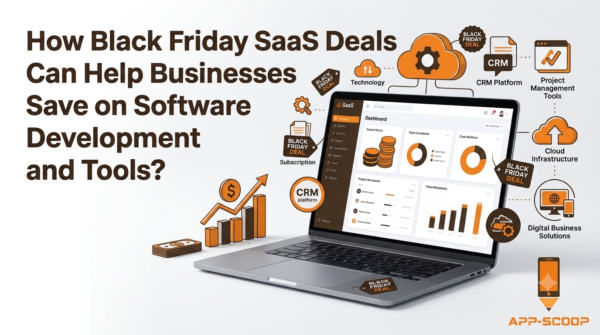
This is where Black Friday SaaS Deals can create opportunities for businesses to review their technology expenses, discover useful software offers, and make more cost-effective purchasing decisions.
Black Friday is widely associated with seasonal shopping discounts, but it can also be an opportunity to evaluate business software subscriptions, development tools, cloud services, and productivity platforms.
For companies planning to launch a new software product or improve an existing application, the season can also encourage a closer examination of their software development budgets.
In this guide, App-Scoop explores how businesses can approach Black Friday software offers, evaluate SaaS subscriptions, manage development expenses, and make technology investments that support long-term growth.
What Are Black Friday SaaS Deals?
Black Friday SaaS Deals are special promotional offers that software companies may introduce around the Black Friday shopping period. These promotions can include discounted subscription plans, reduced annual pricing, extended trial periods, additional features, or bundled software packages.
SaaS, or Software as a Service, refers to software applications that customers access over the internet, usually through a subscription.
Businesses commonly use SaaS products for:
- Customer relationship management and sales management.
- Marketing automation and email campaigns.
- Accounting, invoicing, and financial management.
- Project management and team collaboration.
- Website hosting and cloud infrastructure.
- Data analytics and reporting.
- Customer support and communication.
- Software development and testing.
Black Friday promotions can make some of these tools more affordable. However, discounts and eligibility requirements vary between providers, and not every software company participates.
Businesses should therefore evaluate individual offers rather than assume that every product will have a seasonal discount.
1. Reduce Software Subscription Expenses
One of the most direct benefits of Black Friday SaaS Deals is the opportunity to reduce software subscription expenses.
Many businesses use multiple paid applications to manage different departments. Monthly subscriptions can gradually increase operational costs, especially when teams subscribe to overlapping platforms or maintain tools they rarely use.
For example, a growing business might pay for separate applications for project management, communication, customer support, email marketing, and reporting.
Black Friday can provide an opportunity to review these subscriptions and identify promotional pricing on tools the business already needs.
Before purchasing, businesses should consider:
- Whether the software solves an existing business problem.
- Whether the discounted plan includes essential features.
- Whether the offer applies to monthly or annual billing.
- Whether the subscription price changes after the promotional period.
- Whether the software can integrate with existing systems.
The objective should not simply be to purchase more software at lower prices. It should be to reduce unnecessary expenses while maintaining useful business capabilities.
2. Make Software Development Tools More Affordable
Software development involves more than writing code. Development teams use different tools to plan projects, manage repositories, test applications, monitor performance, collaborate with designers, and maintain infrastructure.
Some software vendors may introduce seasonal offers on developer-focused products and services.
Depending on availability, businesses can investigate discounts on:
- Code collaboration and repository management tools.
- UI/UX design and prototyping software.
- Automated testing platforms.
- Project tracking and development management tools.
- Cloud hosting and infrastructure services.
- API monitoring and documentation tools.
- Security testing and monitoring applications.
For startups and small development teams, reducing the cost of essential tools can help preserve budgets for product development and other priorities.
However, businesses should compare the actual functionality, usage limits, integration options, and long-term pricing before selecting a development tool.
A discounted application that does not fit the team’s workflow may create additional expenses instead of reducing them.
3. Support Startup Growth With Cost-Effective SaaS Tools
Startups often operate with limited financial resources while working toward important business milestones.
They need to develop products, attract customers, manage operations, and establish reliable technology infrastructure without spending unnecessarily.
Black Friday SaaS Deals may provide opportunities to purchase useful business applications at promotional prices.
For example, an early-stage startup might evaluate:
CRM software: Helps organize customer information, manage sales activities, and track business relationships.
Marketing automation: Supports email campaigns, lead nurturing, and repetitive marketing tasks.
Project management software: Helps teams organize responsibilities, monitor deadlines, and coordinate development work.
Analytics platforms: Provide information about website traffic, user engagement, and business performance.
Cloud services: Support application hosting, storage, deployment, and infrastructure management.
The right combination of tools depends on the startup’s business model, team size, technical requirements, and available budget.
Instead of subscribing to every discounted platform, founders should prioritize applications that address immediate operational needs.
4. Explore Opportunities to Improve Cloud and Infrastructure Costs
Cloud infrastructure is an important part of modern SaaS development. Businesses use cloud platforms to host applications, store information, manage databases, and support growing user activity.
Infrastructure expenses can increase as applications attract more customers and process larger amounts of data.
During the Black Friday season, businesses can investigate whether their existing infrastructure providers offer promotional pricing or additional credits.
Potential areas to review include:
- Cloud computing services.
- Database hosting.
- File storage and backup solutions.
- Application monitoring.
- Website hosting.
- Development and staging environments.
- Content delivery services.
However, businesses should understand the difference between discounted subscription software and usage-based cloud infrastructure.
Cloud services may involve additional charges based on computing resources, storage, bandwidth, or data transfer.
A promotional credit or reduced introductory rate does not necessarily represent the total long-term operating cost.
Reviewing usage patterns and estimating future requirements can help businesses make more informed infrastructure decisions.
5. Invest in Software That Improves Business Productivity
Saving money is important, but the real value of a software investment comes from how effectively it supports business operations.
A suitable SaaS application can help teams reduce repetitive tasks, improve collaboration, organize information, and make better-informed decisions.
For example:
- Automated customer support tools can help manage repetitive customer inquiries.
- Marketing platforms can streamline campaign management.
- Reporting applications can make business data easier to understand.
- Collaboration platforms can improve communication between distributed teams.
- Workflow automation tools can reduce manual administrative activities.
When evaluating Black Friday SaaS Deals, businesses should focus on the productivity improvements a tool can realistically provide.
It is also useful to consider whether employees will adopt the application, whether training is required, and whether the software integrates with existing business systems.
A tool that saves money but introduces unnecessary complexity may not deliver meaningful business value.
6. Understand the Difference Between SaaS Subscriptions and Custom Software Development
Not every business requirement can be addressed through an existing SaaS subscription.
Ready-made software is often suitable for common business activities. However, companies with specialized workflows, unique product ideas, or complex integration requirements may need custom software development.
For example, a business might require:
- A customer portal with specialized functionality.
- A multi-tenant SaaS application.
- A custom subscription and billing system.
- Industry-specific business automation.
- A platform that connects multiple third-party applications.
- An AI-powered application built around proprietary business processes.
In these situations, purchasing several discounted software subscriptions may not provide the required flexibility or control.
Custom SaaS development allows businesses to build applications around their specific requirements rather than adapting every workflow to an existing product.
At App-Scoop, the focus is on building production-ready SaaS applications, web applications, and mobile applications for businesses.
The company’s development approach follows three stages:
Execution Blueprint: The project begins with planning, architecture decisions, integration mapping, security considerations, and a defined scope.
Precision Build: The development team builds the application against the agreed blueprint, with working checkpoints and a focus on architecture and functionality.
Launch and Stabilization: The application undergoes testing, performance improvements, and stabilization before and after launch.
This approach is designed to help businesses understand what they are building before development progresses.
7. Make Better Technology Investments With Fixed-Scope Development
One important consideration for businesses planning custom software development is project scope.
Unclear requirements, changing priorities, and unexpected technical challenges can make software projects difficult to manage financially.
A fixed-scope development approach helps establish project expectations before implementation begins.
Typically, this involves defining:
- Required features and functionality.
- Technical architecture.
- Third-party integrations.
- Security requirements.
- Development milestones.
- Project deliverables.
- Timeline and pricing.
App-Scoop uses its Execution Blueprint process to define the project’s architecture, scope, timeline, and fixed price before the main development work begins.
For businesses evaluating their technology budgets during Black Friday, this is an important distinction: purchasing a discounted tool and investing in custom software development are different decisions.
A software subscription provides access to an existing product, while custom development creates an application based on specific business requirements.
The right choice depends on the problem, expected usage, customization needs, and long-term ownership requirements.
8. Consider AI Development and Existing AI-Built Applications
Artificial intelligence is increasingly being incorporated into business software.
Companies are exploring AI assistants, intelligent search, workflow automation, document processing, and recommendation systems to improve their products and internal operations.
Black Friday may also provide opportunities to evaluate AI software subscriptions and developer tools, depending on the offers available.
However, businesses should consider more than the initial subscription price.
Important factors include:
- Monthly usage limits.
- API pricing and additional consumption charges.
- Data privacy and security.
- Integration capabilities.
- Model performance.
- Vendor support and service limitations.
Another consideration is the quality of applications built using AI coding tools.
AI-assisted development can accelerate prototyping and implementation, but an application still needs appropriate architecture, testing, security reviews, and performance validation before it is ready for production use.
App-Scoop provides AI-built MVP stabilization services for businesses that already have applications but need improvements in areas such as security, code quality, performance, and scalability.
This can be relevant for founders who want to improve an existing product rather than automatically rebuild it from scratch.
9. How to Evaluate Black Friday SaaS Deals Before Purchasing
Not every seasonal promotion represents genuine long-term savings.
Businesses should carefully evaluate the complete subscription terms before making a purchase.
Here is a practical checklist:
- Compare the regular and promotional prices.
Calculate the actual difference between the standard subscription price and the promotional price.
- Check the renewal amount.
Find out what the subscription will cost after the promotional period ends.
- Review the billing conditions.
Check whether the offer requires annual payment, a minimum subscription period, or an upfront commitment.
- Understand feature restrictions.
Some discounted plans may have limitations on users, storage, integrations, automation, or usage.
- Verify cancellation terms.
Understand how to cancel the subscription and whether refunds are available.
- Check data portability.
Make sure you can export important business information if you decide to change providers.
- Evaluate customer support.
Consider whether the provider offers support that matches your business requirements.
- Purchase from official sources.
Verify promotional offers through the software provider’s official website rather than relying exclusively on third-party coupon listings.
The Federal Trade Commission also recommends checking subscription renewal prices, understanding automatic billing, and knowing how cancellation works before signing up.
10. Build a Smarter Software Budget for Long-Term Growth
Black Friday is a useful opportunity to review technology expenses, but software purchasing should always support a broader business strategy.
Businesses should consider creating a technology budget that separates recurring subscriptions, infrastructure expenses, development investments, maintenance, and future upgrades.
A simple software budgeting framework can include:
| Expense category | What to evaluate |
| SaaS subscriptions | Monthly and annual subscription costs |
| Development tools | Design, testing, coding, and collaboration tools |
| Cloud infrastructure | Hosting, storage, computing, and bandwidth |
| Custom development | Application design, development, and integration |
| Security | Testing, monitoring, and protection |
| Maintenance | Updates, bug fixes, and technical support |
| AI services | API usage, subscriptions, and infrastructure |
This approach helps businesses understand where their money goes and identify opportunities to optimize spending.
It also reduces the risk of making purchases simply because a promotional offer appears attractive.
The ultimate goal is to invest in software that supports business efficiency, customer satisfaction, and sustainable growth.
How App-Scoop Helps Businesses Build and Improve SaaS Applications?
Choosing the right software tools is one part of a company’s technology strategy. Businesses developing their own digital products also need a reliable development approach.
App-Scoop works with businesses that want to build SaaS applications, web applications, and mobile applications or improve existing products.
Its services include:
- Custom SaaS application development.
- SaaS MVP development.
- Web and mobile application development.
- AI integration and workflow automation.
- AI-built MVP stabilization.
- API and system integration.
- Application modernization and scaling.
App-Scoop’s development process emphasizes planning before coding, architecture-first implementation, security considerations, and post-launch stabilization.
The company also uses AI-assisted development under senior engineering oversight, with code reviews and testing as part of its delivery approach.
For businesses considering a new software product, an existing MVP, or a complex application, understanding the technical requirements before committing to development can help avoid unnecessary rework.
Conclusion
Black Friday SaaS Deals can provide businesses with an opportunity to review software expenses, explore promotional subscriptions, and identify tools that support productivity and operational efficiency.
However, the best purchasing decision is not necessarily the one with the biggest advertised discount. Businesses should evaluate renewal pricing, functionality, integration requirements, security, and long-term value before subscribing.
For startups and growing companies, the season can also be a good time to reassess broader software development plans.
Whether a business needs an existing SaaS tool, a custom application, improved cloud infrastructure, or stabilization of an AI-built MVP, the focus should remain on choosing technology that solves real problems.
At App-Scoop, the emphasis is on helping businesses turn software ideas into production-ready applications and improve existing products through structured engineering and development.